Monday, November 3, 2014

Coping with Weeds


By Pat Curran

Question:  How can I stay ahead of the weeds?

Answer: 

Persistence is the key to weed control, but life gets in the way.  It helps to identify your weeds, or at least be familiar with their life cycle.  Why?  This will help you do triage when time is limited.

Annual weeds grow fast, but it is critical to prevent them from producing seeds.  Otherwise, you have a ‘seed bank’ in your soil that may persist for 10 years or more.  Years ago, I had redroot pigweed spring up in my veggie garden.  It was 2 feet tall before I could deal with it.   I got it all pulled up before it seeded, and I haven’t seen a single plant since.  Obviously, the seeds came in my soil amendments.  On the plus side, they germinated all at once.  Prickly lettuce is another annual weed that may come with purchased compost that didn’t get hot enough to kill weed seeds.  Be sure to wear old clothes (the juice stains!) and remove it before the fuzzy seeds get loose!  At this time of year, it makes sense to remove ‘winter annuals’ like henbit which will flower and produce seed in very early spring.

common burdock
Arctium minus 
Foliage
Mary Ellen (Mel) Harte 

Many of us are familiar with burdock and mullein.  Both European imports, they are biennials.  The first year, there is a rosette of leaves.  The second year, they send up a flowering shoot.  If time and energy permit, dig or pull them up the first year, especially the burdock which has no ornamental value.  The mullein can be left to enjoy the furry gray leaves and leave the yellow flowers for the bees.  As the flowers fade, I cut the spike off and put it in the trash.

Perennial weeds live for years.  Dandelions and plantain are two common lawn weeds.  Plantain tolerates compaction and salt and thus tends to grow next to sidewalks.  I don’t advocate using lawn herbicides, as they have been implicated in dogs getting cancer.  Just keeping the lawn mowed to the recommended height, 3 inches, will keep the grass vigorous and decapitate most of the flowers, so that the seeds don’t blow into adjacent ornamental or veggie gardens.

Quackgrass and bindweed are two perennial weeds that require diligence.  They both have spreading white roots.  Bindweed, which resembles a white morning glory, climbs and makes terrible tangles in desirable plants.  Pulling out the foliage and then smothering these weeds by sheet composting with flattened cardboard, combined with weekly checking for new shoots, is the organic option.  It may be necessary to first remove desirable perennials to a holding bed.

Ask a Gardener appears weekly in The Journal during the growing season. For answers to other garden, lawn, landscape and pest questions, call Cooperative Extension at 607-272-2292 or email: growline1@gmail.com. This article was written by Patricia Curran, horticulture program manager at Cornell Cooperative Extension of Tompkins County.

What to do in the Garden this Month

Halloween has passed and in just a few short weeks, we'll be celebrating Thanksgiving.  I look at this time of year as the start of the "Big Celebration".  Gardening is winding down to be replaced by visiting, parties, big dinners, shopping and the general celebration of everything that is family and friends. Enjoy this month as you start moving "indoors" for the upcoming winter.

Here's what to do in your gardens this month:

  • Finish any garden clean-up you haven't gotten to.  Rake leaves, move downed branches, pretty-up your beds for winter. ** Be sure to remove and dispose of any plant material that is diseased.  Do NOT compost it. 
  • Harvest any remaining root crops from your garden.
  • Plant your final batches of spring bulbs.  You can plant until the ground freezes.
  • Continue to water newly planted trees and shrubs until the ground freezes.
  • Mulch around the root zones of newly planted trees, shrubs and perennials.
  • Wrap tree trunks with trunk wraps to protect them from nibbling rodents.
  • Erect wooden tepees to protect foundation plants from breakage when snow and ice slip off the roof.
  • Drain hoses and turn off any outdoor spigots.
  • Your lawn may still be growing - continue to mow as needed.  Don't be afraid to mow over fallen leaves, effectively mulching them.  As long as you don't put down a thick layer, this is helpful to your lawn. 
  • After you have done your final mowing, winterize your lawn mower.  Leave the gas tank empty and have the blades cleaned and sharpened for next spring.
  • Hill mulched leaved over any less - then - winter - hardy plants ( roses, hydrangeas, for example).
  • Make sure the canes of your climbing roses and other climbing plants are securely fastened to their supports. 
  • Put protection around valuable plants prone to deer and other wildlife munching.  Be sure fencing goes high enough that the little folks don't just sit on the snow and munch from there!!  
  • Do not cut back mums as the tops act as a protection and mulch for spring growth.
  • Check stored firewood for insect infestations.   Clear out any unwanted critters and bugs now instead of during the first snow storm of the year, in the dark, when you are in a hurry!
  • Plant and water amaryllis and paper whites bulbs indoors for later flowering.
  • Clean and disinfect your garden tools and send those that need sharpening out for a professional sharpening.
  • Check stored fruit and veggies for problems.  Discard rotted fruit.
  • Indoor plants may need to be moved or given artificial light as the days get shorter.
  • Reduce fertilizer on your indoor plants.  They need a rest too!!
  • Begin feeding non-migratory birds.  Make sure your feeders have been cleaned and rinsed with a 10% bleach solution.  Black oil seeds attract the largest number of species. 
  • Since you turned your compost pile all year long, it should be steaming right now.  Pat yourself on the back!

I love forcing bulbs.  My family, however, hates the smell of narcissus which leaves me with forcing amaryllis. This year, I had to give up on the 3 bulbs I've been forcing for the past 3 years.  They have served me well for 3 years with double flower stalks, four flowers per stalk.  I loved them - one was white, another bright red and the final a peppermint stripe.  Lovely!!  This fall, they all went kaput: they hit their limit and I've purchased new bulbs.  Hopefully the new bulbs will be as fruitful. :)    Here is a link to a fact sheet from Iowa State University about forcing bulbs.  I hope you find it useful and that just seeing this post will encourage you to start a few bulbs today!

Tuesday, September 2, 2014

Tomato Problems

By Pat Curran

Question:
I have spotty leaves and green tomatoes, not red ones .  How can I do better next year?

Answer:
Despite being a favorite ‘vegetable,’ tomatoes have their problems.  Recently, late blight was reported in the area of Rt. 79 east, and then at the Cornell research farm near Freeville.  Late blight fungus was responsible for the Irish potato famine that killed a million people and caused many to emigrate, rather than starve.  It destroyed the storage potatoes as well as the plants in the fields.

1575711
late blight
Phytophthora infestans
Gerald Holmes
Several years ago, we had an outbreak of late blight that was atypically early, due to infected tomato transplants at the big box stores.  Normally, late blight appears later in the growing season.  It can wipe out farm fields of potatoes and tomatoes, as well as home gardens.  Usually late blight overwinters only on living plant tissue such as potatoes left in the ground.  It will not overwinter on frozen tomato plants, stakes, labels, or in the soil itself (yet).  However, it is important to remove infected plants so as not to spread the disease.  

Cornell researchers are hard at work, developing tomatoes varieties resistant to late blight.  Several Tompkins County Master Gardeners are trialing ‘Iron Lady’ tomato this year.

So what about early leaf spots?  Early blight and septoria are two fungus diseases that typically appear earlier in the season.  These fungus diseases DO overwinter in the soil, so we recommend crop rotation.  Tomatoes and potatoes are in the same plant family, so that is not a true rotation.  For a list of vegetable plant families, please contact the GrowLine horticultural hotline for “Rotating Plants by Family.”

Septoria on Tomato

Paul Bachi

Other tomato problems include fungus diseases, verticillium and fusarium, and nematodes.  Many tomato varieties are labeled ‘VFN’, indicating resistance to these problems.  Heirloom tomatoes may or may not have resistance, but seed companies don’t usually run tests to determine this.

Another frequent tomato problem which we don’t seem to have this year, is blossom end rot.  This black blotch at the bottom of the tomato is caused by a calcium deficiency, which in turn is caused by uneven watering, which impairs calcium uptake by the roots.  We see it more in dry years when gardeners either don’t water enough or often enough, or don’t apply mulch.  If I plant deeply in my clay soil amended with organic matter, and mulch with rotten leaves, I never see blossom end rot.
Cool nights are to blame for the lack of ripe tomatoes this year.  Try draping row cover over the plants to trap and retain some more heat.  Let’s hope for warm weather in September!

Ask a Gardener appears weekly in The Journal during the growing season. For answers to other garden, lawn, landscape and pest questions, call Cooperative Extension at 607-272-2292 or email: growline1@gmail.com. This article was written by Patricia Curran, horticulture program manager at Cornell Cooperative Extension of Tompkins County. 

What To Do in the Garden This Month

By Jean Gerow

Whew!  Fall is right around the corner and we find ourselves busy harvesting, canning, freezing and generally enjoying the bounty of another great year in the garden.  As you enjoy Labor Day celebrations, take a few minutes and walk through your gardens.  Enjoy the beauty you have created (with a little help from Mother Nature!!) and actually smell some flowers.  Roses are my favorite but any will do.  Watch out for small bees and crab spiders: it's a busy time for them as well!!!

Here are a few tasks to do this month.


  • Cool nights and ample precipitation mean it is time to fertilize your lawn.
  • Early September is an excellent time to sow grass seeds.  Be sure to water the area seeded frequently so it grows in well.
  • Pick your warm season veggies before frost hits.  This includes squash, melons, tomatoes, eggplants and peppers.  
  • Pumpkins and gourds should be ready now.  Store in a dry, cool cellar after washing with a weak bleach solution to retard mold.
  • Pick herbs on a cool, dry morning for drying or freezing.
  • Sow lettuces and mixed greens for harvest later in the season.
  • Turn your compost pile.
  • Begin planting spring flowering bulbs in your flower beds.
  • Divide your day lilies and give some to your friends. 
  • Divide and plant spring blooming perennials now, especially if they haven't been divided in 3 or more years.  These make fabulous gifts for your gardening buddies!
  • Remove spent annuals.
  • Houseplants that have been kept outside should get a good washing before bringing in the house.  Check their pots for ants, spiders, or any insect you do not want in your house. 
  • Later in the month, begin planting your garlic for next year.  


Monday, August 18, 2014

August Gardening Update


By Pat Curran


Question:

What’s doing well in our area this summer?

Answer:

The only consistent thing about upstate NY weather is its inconsistency!  After several overnight temps in the lower forties, here’s a report on veggies and flowers.

Tomatoes are slow to produce and ripen this summer.  Here’s the latest from Cornell plant pathologist Tom Zitter (via e-mail Tues. evening).  He reports tomato late blight that he observed in his garden just off Rt. 79 in the Town of Ithaca.  He advises homeowners to harvest any fruit that is starting to show color, unless they plan to spray, or they are growing the new resistant varieties.  There will be “perfect conditions for late blight” due to the cool damp weather.


1575711
late blight
Phytophthora infestans
Gerald Holmes
Although tomatoes have been producing barely enough for a couple of salads each week, some adjacent veggies (growing in large containers in the hottest, sunniest exposure available at my cool country location) have surpassed expectations.  ‘Swallow’ eggplant is a slender purple eggplant that never gets bitter.  The first fruit arrived around July 10th, and the plants are loaded with more.  This is also a very attractive plant, suitable for mixing with ornamentals, with its purple-flushed foliage and large purple flowers.  Cover the young plants with row cover until they get big enough to outgrow fleabeetle damage. 

 ‘Jimmy Nardello’ sweet pepper is an heirloom skinny frying type that appears to ignore cool nights.  Even last year when planted in the ground, it produced lots of peppers for freezing.  Basil is growing well, also in containers (I like to take a few plants in for growing at a sunny windowsill during the winter).  The okra?  Lots of flowerbuds, but little fruit set so far.  The broccoli in the veggie garden looks good.  This would have been a good season to plant snap peas late in May, but I didn’t because they fade away in hot weather.  Had I known!

As for flowers, daylilies are blooming longer than usual, as they tend to do with lots of moisture.  Perennial phlox and beebalm also appreciate the extra rain.  Cardinal flower is in bloom now in damp light shade.  Clethra, summersweet, a fragrant and very adaptable native shrub, is flourishing too.  Look for the pink variety ‘Ruby Spice.’

hydrangea, Hydrangea spp.  (Rosales: Hydrangeaceae) - 5458061
hydrangea
Hydrangea spp. 
Photo by Karen Snover-Clift
Hydrangeas are looking good, if they are the types that bloom on the current season’s growth.  ‘Quickfire’ is an earlier-blooming paniculata hydrangea with pinker blooms; ‘Limelight’ blooms a little later with green-tinged clusters.  ‘Annabelle’ and pink ‘Invincibelle Spirit,’ cultivars of the native Hydrangea arborescens, are very handsome.  Hydrangeas that carry their flowerbuds on last season’s growth may have been killed to the ground by last winter’s weather – so no flowers this year.


Ask a Gardener appears weekly in The Journal during the growing season. For answers to other garden, lawn, landscape and pest questions, call Cooperative Extension at 607-272-2292 or email: growline1@gmail.com. This article was written by Patricia Curran, horticulture program manager at Cornell Cooperative Extension of Tompkins County.

Tuesday, August 5, 2014

Time to Think about Spring-Flowering Bulbs


By Pat Curran


Question: Which spring-flowering bulbs are easy and reliable?

Answer:
It’s barely August, but yes, it’s time to think about where to add spring bulbs to the garden.  Having returned from vacation, I have been busy weeding the flower and shrub beds.  I have never seen Narcissus (daffodil) foliage still green in early August before.   I have been ruthlessly cutting it down while I weed and mulch.  However, lingering Narcissus foliage is something to consider.  It’s often green until early July, and one is not supposed to tie it up or remove it before then.  It’s not really unsightly, but it certainly makes maintenance harder.  Now I am paying even more attention to bulbs that mature their foliage quickly.

Puschkinia scilloides
Puschkinia, 2014

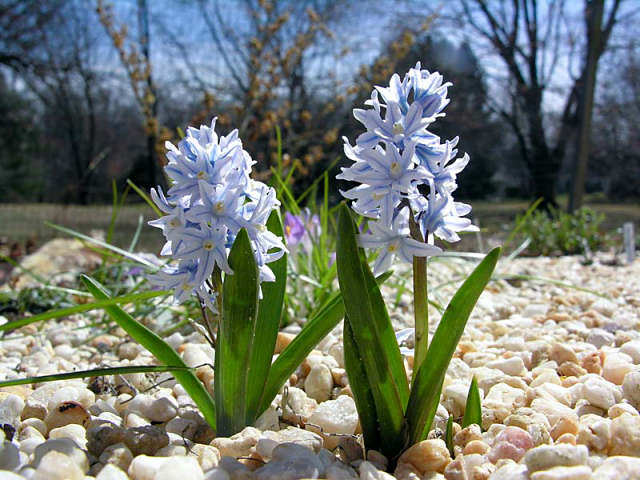
Early spring bulbs that naturalize (spread by seed) well and go dormant soon after blooming include Siberian squill (closest to a true blue, and also available in white), glory-of-the snow (lavender-blue, pink, or white), and Puschkinia (white flowers with turquoise stripes).  These are all small plants suitable for the front of the border.  If you have a shady lawn under deciduous trees, they will do well there planted in the thin grass.   Anemone blanda is a delightful little naturalizer.  Flowers in blue/purple, pink, or white, attractive ferny foliage, long bloom time, and animal resistance all combine to make it a great edging for a flower bed.  Grecian windflower is not a true bulb; instead, it has odd-shaped dark little tubers.  Soak them briefly in warm water before planting, and don’t worry about which side of the tubers is up.

Spanish bluebell is a late spring bloomer that multiplies well.  Tolerant of partial shade, it blooms in lavender-blue, pink, or white.  Like most bulbs, it is more effective in the landscape in groups of a single color.  When I moved a Hosta last year, I was just stunned by the number of nearby bluebell bulbs I found.  The taxonomists keep changing the scientific name, but the most recent version is Hyacinthoides hispanica.

Fritillaria meleagris, the checkered lily or guinea hen flower, is a small plant with narrow inconspicuous foliage.  The flowers are drooping bells either in mauve with a checkerboard effect, or all white.  Plant this one where it will be easily seen up close.  Native to western Europe, the checkered lily is happy in partial shade and will also naturalize.  The bulbs, however, are delicate, relatively soft and fleshy.  Plant them immediately as they are prone to drying out.

Look for Narcissus ‘Hawera,’ a smaller variety.  A charming May bloomer, its narrow leaves go dormant relatively quickly.   Plant in the front where it can be appreciated.


Ask a Gardener appears weekly in The Journal during the growing season. For answers to other garden, lawn, landscape and pest questions, call Cooperative Extension at 607-272-2292 or email: growline1@gmail.com. This article was written by Patricia Curran, horticulture program manager at Cornell Cooperative Extension of Tompkins County.
Friday, August 1, 2014

Good Bugs

By Tracy McLellan, Master Gardener Volunteer

Question: What can I do to encourage beneficial insects in my garden?

Answer: We tend to notice the insects that damage our plants.  However the vast majority of insects and related animals called arthropods are either harmless or beneficial.  They perform the useful functions of pollination, predation, parasitism, and decomposition.

Bees and some flies transfer pollen from one flower to another, ensuring that the plants produce fruit. Pollination is particularly important for fruit trees and squash plants.  

Familiar and easily seen, ladybugs and praying mantises are predators on other insects that eat plants.  Spiders, centipedes and green lacewings are predacious and can devour pests. Ladybug and lacewing larvae look similar, rather like striped worms.  Both prey on aphids, sucking insects with soft bodies that are common on many kinds of plants. 

Tiny parasitoid wasps and some types of flies lay their eggs in the bodies of other insects and digest them from the inside. Parasitoids are often highly specific to one host animal, so they might help out with only one pest species.

 
Ichneumonid parasitoid wasps
Enicospilus spp.
Merle Shepard, Gerald R.Carner, and P.A.C Ooi

We can provide beneficial insects with a good home by making our gardens comfortable for them throughout the season they are active.  Provide flowers for pollinators at times in addition to when our fruit trees and vegetable plants need them, and plant those flowers close to those plants.  Provide food plants for the other life stages, which might eat leaves when they are juveniles and visit flowers when they are adults. Flowers in the carrot (parsley) and daisy families are good hosts for pollinators. Cover crops such as buckwheat and clover are great if you have enough space.  Have water available at all times.  Use straw mulch or leave pulled weeds on the soil surface, as long as the weeds do not have seeds, to give insects places to hide from their predators.

A high diversity of plants provides a variety of habitats and food sources.  That means lots of different varieties within species, and a large number of species.  Many different plant types, from ground hugging to shrubs and trees, encourage good insects.  Mixing plantings of vegetables, ornamental, trees and shrubs is a great way to provide good homes for good bugs and makes for an interesting garden. A huge, closely mown lawn does nothing to enhance the good insects in your garden.

If you do use insecticides, do not spray everything heavily, but focus on the infestation you are aiming to eliminate.  Even the less toxic, organically approved insecticides are broad spectrum and will kill most insects, including those that it would be good to keep around.

For more information on beneficial insects, visit the Cornell Garden-Based Learning website:

What to do in the Garden this Month


The "dog days" of summer are here. The Romans called this time of the year the "dog days" because the star Sirius rose right before sunrise at this time.  Sirius is the brightest star of the constellation Canis Major ~ the large dog.  As time has passed, the rotation of the stars has shifted and we no longer see Sirius rise before sunrise during summer.  However, the name stuck.  

The Romans sacrificed a small brown dog at this time to keep Sirius happy.  A mad Sirius caused hot, dry weather: a happy Sirius gave the Romans a nice, tolerable summer.  Rather than sacrificing a small brown dog, let's just give thanks for the bounty of our gardens and the beauty they provide.  Take time during your day to send appreciative thoughts out to your garden and the stars.  Who know, maybe Sirius will bring us wonderful weather!

What to do in the garden this month:
  • Keep watering your new woodies.
  • Weed, weed, deadhead and weed some more.
  • Scout local nurseries for great bargains and talk to your gardening friends and trade plants.
  • When planting new perennials, water the planting hole before you plant, then water again after planting and mulch your new plant well.
  • Use the hot dry weather to tend to garden structures that need paint, repair or staining.
  • Continue to photograph your garden and individual plants, recording in your journal what you love and any ideas you have for next season.
  • Water and fertilize your container plants.  Pinch petunias and other flowering plants back to encourage more blooms.
  • Later in the month, install trunk protectors on trees to keep bucks from rubbing their antlers on them in the fall.
  • Harvest tomatoes regularly.  Visit your veggie garden daily to harvest, weed, and look for pests.  Squash, pole beans, cucumbers all respond from regular picking by producing more produce.
  • Day-neutral strawberries may produce another crop if regularly watered.
  • August 10 is the target date for your last planting of broccoli and cauliflower transplants as well as seeding of lettuce, spinach, and turnips. 
  • Late August, pinch melon and winter squash vines back after they have set all the fruit that can mature in time.
  • Early potatoes can be harvested.  If early blight is nearby, definitely harvest now!
  • Check your fencing and make repairs as necessary.  Your gardens should look fabulous both to you AND to the deer, rabbits and groundhogs nearby. :)
  • Turn your compost pile (or at least keep adding to it!!)

Ahhh, keep your tools sharp and your mulch pile growing - enjoy the bounty of your garden.  

Tuesday, July 29, 2014

Plant Sex, And Why It Matters

By Pat Curran

Q:  I’ve heard that holly plants are either male or female.  Can you explain this?

A:  Holly plants are indeed either male or female.  The term for this is ‘dioecious.’  The female holly needs pollen from the male holly’s flowers to fertilize her flowers to produce fruit.  (An occasional ‘perfect’ flower, i.e. with all the reproductive parts, may produce a fruit.)  The most common evergreen hollies we grow are the hybrid ‘blue’ hollies, developed by Mrs. Meserve in NYS.  They are hardy to zone 5 and prefer an east or northeast exposure.  This winter, my ‘Blue Princess’ holly experienced leaf browning to an extent unprecedented in 20 years.  However, vigorous new growth is emerging from the dormant buds under the bark.  If you are uncertain whether a branch is dead, scratch the bark gently and look for the green that will indicate life.  Dormant buds take time to develop, however, so don’t give up hope too soon.

common winterberry, Ilex verticillata  (Celastrales: Aquifoliaceae) - 5475819
common winterberry
Ilex verticillata 
Fruit(s)
Photo by Rob Routledge
Other woody species may also be dioecious.  Bayberry, spicebush, and fringetree are three dioecious native shrubs.  While their fruits are very attractive to birds, it is difficult to buy a shrub of known sex.  Winterberry is a native deciduous holly with red fruits on leafless stems in late fall and winter, often in wet areas.  On a recent garden trip in southeast PA, we observed winterberry in bloom.  It was quite easy to distinguish the sex of the flowers – no hand lens needed.  A quick visit to the nursery may be in order, if the potted shrubs are mature enough to flower.

So what is the purpose of the dioecious condition?  Well, just like with people, it insures that genetic recombination happens, rather than self-pollination.  The male and female plants are genetically different in many more ways than their sex.  Genetic recombination of traits is an evolutionary safeguard.  As growing conditions vary, some plants will be better adapted than others.  Vegetative reproduction may be more efficient, but it is riskier when growing conditions change.

5401993
lily
Lilium spp. 
Flower(s)
Photo by Lesley Ingram
Plant sex is much more varied than animal sex.  Plants may have ‘perfect’ flowers with all the reproductive parts, or they may have separate male and female flowers, but on the same plant.

There are also other mechanisms to prevent self-pollination.  Male and female flower parts may mature at different times, but even if they mature at the same time, self-pollination may be prevented.  Apples, for instance, need not just another apple tree, but a different apple tree, for pollination to occur.  Not all apple or pear varieties pollinate one another, either.  Always check the pollination requirements before selecting fruit plants.


Ask a Gardener appears weekly in The Journal during the growing season. For answers to other garden, lawn, landscape and pest questions, call Cooperative Extension at 607-272-2292 or email: growline1@gmail.com. This article was written by Patricia Curran, horticulture program manager at Cornell Cooperative Extension of Tompkins County.

Sunday, December 1, 2013

What to do in the Garden this Month

The Holidays are in full swing!  Break out the pumpkin pie (made from your own pumpkins), mashed potatoes, corn, peas, carrots - all from your garden!!  If you brew your own beer or wine, it's time to uncork a few bottles and toast the season!

Who wants to work in the garden in the snow?  Not me!  If you've followed our posts throughout the year, you should be ready to take a break and enjoy the indoors this month.  Here is a list of items concerning Holiday plant care for you instead of garden care.

  • Give holiday plants such as poinsettia adequate light and water. In general, keep plants away from drafts and heat sources.
  • Maintain even moisture and remove the decorative foil or plastic pot covers that can cause root rot. Water over the sink and let the water drain out completely.  You then can replace the decorative covers.
  • To ensure your Christmas cactus will flower again next year, keep it dry and at a temperature of about 55 degrees for the next two months.
  • Real mistletoe is fatal for pets - beware.
  • You still can force bulbs.  Place them in a cold place for 2 months then pot them up.
  • If you have a live tree for the holiday, dig the hole it will go into now before the ground freezes.  It's best to only keep the tree inside for one week then plant it outside.
  • Cut the boughs off your Christmas tree (after the holiday, of course!!) and use them to mulch your perennial beds.  

 Poinsettia are very popular this time of the year.  Here are few poinsettia facts for you:

  • Keep them moist but not wet.  A dry plant will lose it leaves quickly and a wet plant will rot.  Test your soil daily.
  • They like temperatures between 65- 70 degrees during the day and no lower than 60 degrees at night.
  • Place them in a sunny window.  South facing is best.
  • If you want to keep them year round and force them to bloom the following year, here is a link to a fact sheet from Ohio State on how to do this.  Generally, these plants are composted after the holidays and new purchased the following year. 

Tuesday, October 1, 2013

What to do in the Garden this Month

Indian Summer is upon us!  We never know if or when a blast of warm weather will hit, but we love it when it does!  Don't worry, frost will be here and the leaves will change all too soon.  I love to start new hardscape projects this time of the year.  My enthusiasm for gardening has not dropped off but harvesting and maintenance has, giving me time and energy to build a new fence or put in a new bed.  There's always a bed to dig up and re-do ~ it's a wonderful time of year to dig!!

Here's a list of tasks for the garden this month.  Enjoy!

  • Dethatching your lawn is a great task to do early this month.   
  • Rake leaves and add them to your compost pile.
  • While you are at it, turn the compost pile.
  • Dig up tender herb plants such as rosemary, thyme and transplant in containers to bring indoors.  These plants need a rest period so keep them in a cooler area of your house over the winter.  Enjoy adding them to culinary dishes throughout the winter.
  • Brussel sprouts, kale, and kohlrabi are cold-tolerant veggies and best harvested in cooler weather. 
  • Plant garlic cloves for next season.  
  • Beets, carrots, leeks and turnips will survive into early winter if mulched with straw or leaves. 
  • Continue to add spring flowering bulbs to your gardens.
  • Cut dahlias back and dig up the tubers after the first heavy frost. Brush off dirt and air dry.  Share some with your friends.  Store tubers in a cardboard box between layers of vermiculite, peat moss, saw dust or wood shavings.  The bulbs can also be potted in a soilless mix and stored in the cellar or heated garage.  Do not water until mid-May. Store at 35 - 45 degrees.
  • Canna bulbs must be dug up once a heavy frost hits.  Cut back the stalks, dig up the bulbs and store them in an airy container with peat moss or rice hulls to help maintain bulb moisture.
  • Transplant trees or shrubs now. Water them well.
  • Gather fallen leaves, twigs, fruit and debris to keep disease at a minimum. 
  • Remove spent annuals from your garden.  Compost them. :)
  • Cut back spent perennial foliage to 3" or so.  Compost the stalks.

Sunday, September 1, 2013

What to do in the Garden this Month

Whew!  Fall is right around the corner and we find ourselves busy harvesting, canning, freezing and generally enjoying the bounty of another great year in the garden.  As you prepare for the upcoming Labor Day celebrations, take a few minutes and walk through your gardens.  Enjoy the beauty you have created (with a little help from Mother Nature!!) and actually smell some flowers.  Roses are my favorite but any will do.  Watch out for small bees and crab spiders: it's a busy time for them as well!!!

Here are a few tasks to do this month.

  • Cool nights and ample precipitation mean it is time to fertilize your lawn.
  • Early September is an excellent time to sow grass seeds.  Be sure to water the area seeded frequently so it grows in well.
  • If broadleaf weeds (dandelions or plantains, for instance) are a problem in your yard, herbicides can be effective if applied now and in accordance with product recommendations.  Alternatively, hand weeding in moist soil helps - be sure to get the taproot!!
  • Pick your warm season veggies before frost hits.  This includes squash, melons, tomatoes, eggplants and peppers.  
  • Pumpkins and gourds should be ready now.  Store in a dry, cool cellar after washing with a weak bleach solution to retard mold.
  • Pick herbs on a cool, dry morning for drying or freezing.
  • Sow lettuces and mixed greens for harvest later in the season.
  • Turn your compost pile.
  • Begin planting spring flowering bulbs in your flower beds.
  • Divide your day lilies and give some to your friends. 
  • Divide and plant spring blooming perennials now, especially if they haven't been divided in 3 or more years.  These make fabulous gifts for your gardening buddies!
  • Remove spent annuals.
  • Houseplants that have been kept outside should get a good washing before bringing in the house.  Check their pots for ants, spiders, or any insect you do not want in your house. 
  • Later in the month, begin planting your garlic for next year.  


Thursday, August 1, 2013

What to do in the Garden this Month

The "dog days" of summer are here. The Romans called this time of the year the "dog days" because the star Sirius rose right before sunrise at this time.  Sirius is the brightest star of the constellation Canis Major ~ the large dog.  As time has passed, the rotation of the stars has shifted and we no longer see Sirius rise before sunrise during summer.  However, the name stuck. 

The Romans sacrificed a small brown dog at this time to keep Sirius happy.  A mad Sirius caused hot, dry weather: a happy Sirius gave the Romans a nice, tolerable summer.  Rather than sacrificing a small brown dog, let's just give thanks for the bounty of our gardens and the beauty they provide.  Take time during your day to send appreciative thoughts out to your garden and the stars.  Who know, maybe Sirius will bring us wonderful weather!

What to do in the garden this month:
  • Keep watering your new woodies.
  • Weed, weed, deadhead and weed some more.
  • Scout local nurseries for great bargains and talk to your gardening friends and trade plants.
  • When planting new perennials, water the planting hole before you plant, then water again after planting and mulch your new plant well.
  • Use the hot dry weather to tend to garden srtuctures that need paint, repair or staining.
  • Continue to photograph your garden and individual plants, recording in your journal what you love and any ideas you have for next season.
  • Water and fertilize your container plants.  Pinch petunias and other flowering plants back to encourage more blooms.
  • Later in the month, install trunk protectors on trees to keep bucks from rubbing their antlers on them in the fall.
  • Harvest tomatoes regularly.  Visit your veggie garden daily to harvest, weed, and look for pests.  Squash, pole beans, cucumbers all respond from regular picking by producing more produce.
  • Day-neutral strawberries may produce another crop if regularly watered.
  • August 10 is the target date for your last planting of broccoli and cauliflower transplants as well as seedings of lettuce, spinach, and turnips. 
  • Late August, pinch melon and winter squash vines back after they have set all the fruit that can mature in time.
  • Early potatoes can be harvested.  If early blight is nearby, definitely harvest now!
  • Check your fencing and make repairs as necesary.  Your gardens should look fabulous both to you AND to the deer, rabbits and groundhogs nearby. :)
  • Turn your compost pile (or at least keep adding to it!!)

Ahhh, keep your tools sharp and your mulch pile growing - enjoy the bounty of your garden. 

Tuesday, July 30, 2013

Learn About Growing Hazelnuts in NYS

 
Can hazelnuts (filberts) be grown in as a commercial crop in New York State? Visit the rural property of Dawn and Jeff Zarnowski in McGraw, Cortland County on Saturday August 3 and learn about the possibilities. The Zarnowskis have been growing hazelnuts for some fifteen years and they will explain the basics of hazelnut growing and give a tour of their hazelnut plantings.
 
This full day program is sponsored by the New York Nut Growers Association and will feature presentations by leading horticulturists and plant breeders from Cornell University, Rutgers University, Minnesota and Oregon. These presentations will introduce new cultivars of hazelnut that are resistant to disease and freezing. They will report on successful steps taken to mechanize hazelnut planting and harvesting to allow for larger scale commercial production.
 
The full program agenda is below and also available online at www.nynga.org. The program is free and open to the public but registration is requested. There will also be a buffet lunch served on site for $15.00 – registration is required for this to help plan for the buffet lunch. Registration forms can be obtained from the NYNGA website along with driving directions to the Zarnowski property.
 
For more information, contact John Wertis, NYNGA Program Coordinator at (607)387-4331 or at bwwfarmtoday@aol.com 
 
 
   Agenda
8:30-9:00 Sign in, Snacks, and Chat
9:00-9:30 Welcome and Hazelnuts 101 Talk (Jeff Zarnowski)
9:30-10:00 Genetic Diversity in Hazelnut Research (Megan Muehlbauer, Rutgers)
10:00-10:30 Ongoing Hazelnut Research at Rutgers/Hazelnut Consortium Activity (Dr. Tom Molnar, Rutgers)
10:30-12:00 Walk-About and Talk-About: Z's Nutty Ridge LCC, Hazelnuts and Otherwise (Jeff and Dawn Zarnowski)
12:00-1:00 Lunch and Time to Chat
1:00-1:30 NYNGA Meeting
1:30-2:00 West Coast Hazelnut Cultivars in the Northeast (Dr. Tom Potts)
2:00-2:30 Cornell's Dilmun Hill Planting of Mark Shephard Wisconsin Hazelnuts (Prof. Ken Mudge and Cornell Students)
2:30-3:00 Commercial Hazelnut Growing Opportunities in Southern Ontario and Optimism for Hazelnut Plantings in the Future (OMAFRA Literature and Speaker TBA)
 

Monday, July 8, 2013

Final Results of Fava Bean Experiment in Upstate NY

If you've been following this blog since last fall then you know that I've been obsessed with growing fava beans in NY ever since we moved back from Ireland, where 'broad beans' are commonly grown as a winter crop and harvested in spring. It's so nice to harvest something from the spring garden other than lettuce, spinach and other greens, so I was determined to find a way to grow them here.

Go to Growing Fava Beans in Upstate NY Part 1 and Growing Fava Beans in Upstate NY Part 2 if you want to see photos from the early days of this experiment.

 The overal result: Success! We were eating fava beans starting in mid May and are still eating them now in early July, thanks to sowing four different varieties which made for an extended harvest. They have been a wonderful addition to stirfries with spring greens, spring onions and garlic scapes, all from the garden.


Here is a summary of the experiment:
November 2012: Sowed four varieties in cell packs in our solar greenhouse - Banner, Aqua Dulce, Dreadnought and Crimson-Flowered. I also sowed 6 Banner seeds outside under straw just for the heck of it. (Autumn is when they would be sown outdoors in Ireland.)

December 2012-February 2013: Continued to pot up the seedlings into larger and larger pots in the greenhouse.

March 12: Dreadnought and Crimson started flowering in the greenhouse. Flower buds on Aqua Dulce.

March 24: I was worried that the greenhouse was getting too hot during the day for the flower buds, which are said to be intolerant of heat and won't set pods, so during a warm spell I planted some out and set out the rest to harden off on a porch.

March 29: The temperature plummeted to 20F overnight and the plants looked like goners the next morning, completely wilted and flat. I noticed that as the stems thawed  they didn't turn to mush, and  after a few days the stems firmed up again and I was able to stand them up with the help of stakes and string. I had inadvertantly put them through a cold hardiness test. Even the flower buds survived the extreme cold.

April: Continued temperatures below freezing at night but with no harm to the bean plants. Once we could start digging in our garden again we direct-sowed a block of Banner fava beans at the same time we planted peas in early April.


May 15: Started to harvest fava beans to eat. The most productive variety is Aqua Dulce, which produced lots of big pods. Crimson-Flowered is very pretty but the pods are small. Dreadnought has large plants and pods but it didn't make very many. Banner is the latest of the four and flowered prolifically in May. Despite several days in May when temps went into the 90s F most of the flowers continued to set pods. 

 June: Harvested beans twice a week or so. The plants that were direct sown outdoors in April started flowering. Crimson and Dreadnought were finished so removed and the space replanted.

The biggest surprise was that some of the beans that I direct sowed outside in November suddenly sprouted up amongst the kale that I had planted there in the spring, after seeing no sign of the beans! Alas, too late for them to flower and fruit now.

Banner produces many pods per plant

July 1: The Banner that were started indoors are now producing heavily. They were much later than Aqua Dulce which was a good way to extend the harvest. The direct sown Banner in the garden had lots of flowers but few beans, so it didn't work to direct sow them in spring as directed by the Fedco seed catalog (well, this year anyway).

Conclusions:
- I did not need to start the plants so early in the greenhouse. Next year I will wait until late January to early February so the plants do not get so big inside.

- The flowers are not quite as heat sensitive as indicated so I will let them stay in the greenhouse till the weather is settled. However, it's good to know that they can survive down to 20F, recover and still produce beans although it did set them back for a few weeks. I think early to mid April is a good time to plant out 10-12" plants as they can take temps down to 25F without damage.

- It's not worth direct sowing them outdoors unless you can do that in March. Sprouting the seeds first indoors would have helped as the soil was cold and the direct-sown seeds took 3 weeks to germinate.

- The most productive varieties were Aqua Dulce and Banner. Aqua Dulce produced heavily in May and Banner in June/early July. Aqua Dulce has a great flavor but the beans from Banner are a bit bland. I am saving seed from both of these varieties to further select for our local weather conditions.
Aqua Dulce has long pods with many beans inside. 
- Fava beans could also have commercial potential in our area for market gardeners. They are quite cold tolerant and can be started early in the greenhouse then planted outside in April. The pods are impressively large and shiny and look good in a market display. They are something different from greens, greens and more greens at the markets in May. 


- The fresh beans have a unique and delicious  flavor when lightly cooked. There is no need for all that fussy squeezing-out-of-the skin that I see recommended as long as they are harvested when the beans within are not too big.
If you have a greenhouse, why not try growing your own fava beans next year?


Monday, July 1, 2013

What to do in the Garden this Month

July is known for fireworks, picnics and gathering with family and friends.  It is also a fabulous time for your gardens!

What to do in your garden this month:
  • Pinch chrysanthemums back to promote big, bushy growth and increase the number of blooms later.
  • Divide and/or move your bearded iris so they can re-establish before winter.  Share extras with your friends!
  • Deadhead your perennials and weed, weed, weed!
  • If you are going on vacation, chop (if you don't have time to pull) any weeds in your garden.  The goal is to NOT let them go to seed. 
  • Continue to water your new woodies (shrubs and trees) with 10-15 gallons of water each week.
  • Stop fertilizing your woodies and cut out only dead, crossed and diseased branches.
  • Take photos of your lovely plants as they flower.  Place labels near the plants.  Add the images to your garden journal and write the names down on your garden map, recording bloom times and other notes about how each species performs.
  • Fertilize your container plants regularly or use a slow release fertilizer.
  • Keep small veggie transplants watered.
  • Mulch all your gardens, if you haven't already.
  • Got holes in your veggie leaves? Look for slugs and squish them.
  • Succession planting time has begun!  Plan replacement veggies for places where your spring veggies have finished.  For instance, spring peas are done and it's time to plant your next item in that spot.
  • Blueberries will begin fruiting this month.  Get your bird-proof netting out and protect your berries.
  • Actively train your squash vines, tomato plants and any vining, trailing plant.  Tuck stems inside cages, pinch errant vines, encourage growth where you want it now for easy, abundant harvesting later.
  • Harvest garlic late in the month after half the leaves have turned brown.
  • Handpick Colorado potato beetles and scout for other insect pests.
  • Remove yellowed leaves, watch for mildew and keep an eye out for late blight symptoms on your tomato plants. 

Above all else, enjoy your flowers and the abundant harvest from your gardens.  Take time each day to admire their growth and beauty.  Appreciate your hard hard work and pat yourself on the back.


Tuesday, June 25, 2013

Fruition Seed Walk at Remembrance Farm


Fruition Seeds is a brand-new seed company in Naples, NY whose mission is to grow regionally-adapted, certified organic seed for Finger Lakes farmers and gardeners. The enthusiastic and knowledgeable owners of this exciting new venture, Petra Page-Mann and Matthew Goldfarb, are also coordinating with other local organic farmers to grow out some of their seed crops.


On June 10 a group of us gathered to tour the Fruition seed crops at Remembrance Farm in Trumansburg. Farmer-owner Nathanial Thompson told us that since he supplies a huge amount of greens for the Full Plate Farm Collective CSA he spends a lot of money on these seeds and was interested in learning produce his own. Now with direction and assistance from Petra and Matthew he is growing enough seed for several crops to supply his own needs as well as some for Fruition.


On the right side of the photo are Red Russian kale plants going to seed - the plants are loaded with seed pods and very close to ripening. The kale was direct-seeded last fall and stood through the winter, uncovered, in a wind-swept location, thus the survivors have been selected for winter hardiness in our region. Most seed production now takes place in the Pacific northwest which has much milder winters so seed from there isn't as winter-hardy.

 In spring Petra removed any remaining weak or crowded plants, leaving a healthy stand of seed-bearing plants. Brassica plants are incredibly generous with their seeds so there should be many pounds harvested from these rows.


 We saw long rows of mixed salad greens going to seed - mustard, tatsoi, arugula and lettuce. All of these plantings are ones that Nathaniel and Emily were cutting for salad greens, then they stopped cutting and allowed them to go to seed rather than taking them out and replanting with something else. With 25 acres under cultivation, they can afford to use this space for seed production and they know it will save them money on their seed bill next year. 


A group of seedy people contemplating lettuce plants going to seed.  


A mixed planting of red and green lettuce. They are going to allow these different varieties to cross with each other. Nathanial isn't concerned with maintaining varietal purity since he wants to end up with a mix of lettuce types anyway for replanting. He likes a lot of red lettuce in his salad bags so it will be interesting to see if one color is dominant over the other.


If you want to learn more about commercial seed production in the Finger Lakes, there will be a Field Day at Fruition Seeds on Saturday July 27 from 3 to 5 pm. There will be a farm tour and demonstrations of seed cleaning techniques, and the event is free and open to the public.

Fruition Seeds is located at 7970 Hickory Bottom Road, Naples NY.  From Naples, take County Road 36 up the hill a mile or so and take a right on Gulick Road.  In another half mile, take a left on Hickory Bottom Road and the farm will be on the right after a quarter mile, adjacent the large white barns, at 7970.

If you're interested in learning more about seed-saving in a typical home vegetable garden, come to a class on seed saving techniques at CCE-Tompkins, Ithaca NY on Wednesday July 3 from 6:30 - 8:30 pm. Topics covered will include hand-pollination, isolation techniques, flower types and rogueing out off-types. Part of the class will be held outside in the seed-saving garden so dress for the weather. The cost is $5 to $10 (sliding scale fee) and you can register by calling the CCE-Tompkins reception at 272-2292 or send an email to cab69@cornell.edu.


Come learn about seed production and saving for vegetables, herbs and flowers on two organic acres of seed, from arugula to zucchini, tucked in the heart of the Bristol Hills!  We'll have a farm tour and discuss of strategies and challenges in the Finger Lakes. We will also demonstrate simple cleaning techniques with hands-on demonstrations. Come with lots of questions and come away with inspiration, know-how and fresh seed for your summer/fall plantings. - See more at: http://ccetompkins.org/calendar/13/06/07/fruition-seeds-field-day#sthash.T78RJH3G.dpuf