Showing posts with label August. Show all posts

Monday, August 18, 2014

August Gardening Update


By Pat Curran


Question:

What’s doing well in our area this summer?

Answer:

The only consistent thing about upstate NY weather is its inconsistency!  After several overnight temps in the lower forties, here’s a report on veggies and flowers.

Tomatoes are slow to produce and ripen this summer.  Here’s the latest from Cornell plant pathologist Tom Zitter (via e-mail Tues. evening).  He reports tomato late blight that he observed in his garden just off Rt. 79 in the Town of Ithaca.  He advises homeowners to harvest any fruit that is starting to show color, unless they plan to spray, or they are growing the new resistant varieties.  There will be “perfect conditions for late blight” due to the cool damp weather.


1575711
late blight
Phytophthora infestans
Gerald Holmes
Although tomatoes have been producing barely enough for a couple of salads each week, some adjacent veggies (growing in large containers in the hottest, sunniest exposure available at my cool country location) have surpassed expectations.  ‘Swallow’ eggplant is a slender purple eggplant that never gets bitter.  The first fruit arrived around July 10th, and the plants are loaded with more.  This is also a very attractive plant, suitable for mixing with ornamentals, with its purple-flushed foliage and large purple flowers.  Cover the young plants with row cover until they get big enough to outgrow fleabeetle damage. 

 ‘Jimmy Nardello’ sweet pepper is an heirloom skinny frying type that appears to ignore cool nights.  Even last year when planted in the ground, it produced lots of peppers for freezing.  Basil is growing well, also in containers (I like to take a few plants in for growing at a sunny windowsill during the winter).  The okra?  Lots of flowerbuds, but little fruit set so far.  The broccoli in the veggie garden looks good.  This would have been a good season to plant snap peas late in May, but I didn’t because they fade away in hot weather.  Had I known!

As for flowers, daylilies are blooming longer than usual, as they tend to do with lots of moisture.  Perennial phlox and beebalm also appreciate the extra rain.  Cardinal flower is in bloom now in damp light shade.  Clethra, summersweet, a fragrant and very adaptable native shrub, is flourishing too.  Look for the pink variety ‘Ruby Spice.’

hydrangea, Hydrangea spp.  (Rosales: Hydrangeaceae) - 5458061
hydrangea
Hydrangea spp. 
Photo by Karen Snover-Clift
Hydrangeas are looking good, if they are the types that bloom on the current season’s growth.  ‘Quickfire’ is an earlier-blooming paniculata hydrangea with pinker blooms; ‘Limelight’ blooms a little later with green-tinged clusters.  ‘Annabelle’ and pink ‘Invincibelle Spirit,’ cultivars of the native Hydrangea arborescens, are very handsome.  Hydrangeas that carry their flowerbuds on last season’s growth may have been killed to the ground by last winter’s weather – so no flowers this year.


Ask a Gardener appears weekly in The Journal during the growing season. For answers to other garden, lawn, landscape and pest questions, call Cooperative Extension at 607-272-2292 or email: growline1@gmail.com. This article was written by Patricia Curran, horticulture program manager at Cornell Cooperative Extension of Tompkins County.

Tuesday, August 5, 2014

Time to Think about Spring-Flowering Bulbs


By Pat Curran


Question: Which spring-flowering bulbs are easy and reliable?

Answer:
It’s barely August, but yes, it’s time to think about where to add spring bulbs to the garden.  Having returned from vacation, I have been busy weeding the flower and shrub beds.  I have never seen Narcissus (daffodil) foliage still green in early August before.   I have been ruthlessly cutting it down while I weed and mulch.  However, lingering Narcissus foliage is something to consider.  It’s often green until early July, and one is not supposed to tie it up or remove it before then.  It’s not really unsightly, but it certainly makes maintenance harder.  Now I am paying even more attention to bulbs that mature their foliage quickly.

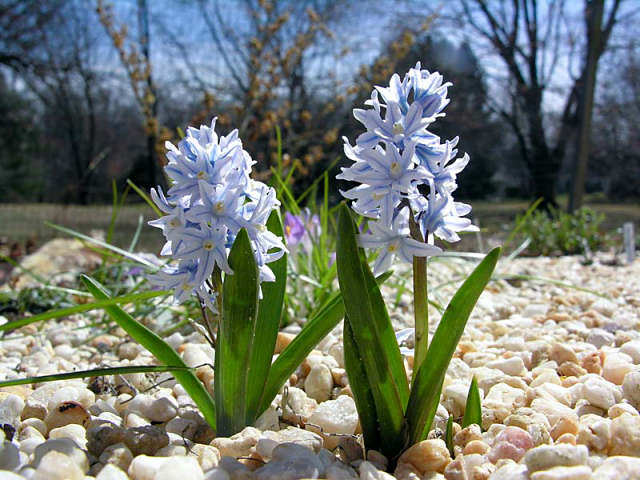
Puschkinia scilloides
Puschkinia, 2014

Early spring bulbs that naturalize (spread by seed) well and go dormant soon after blooming include Siberian squill (closest to a true blue, and also available in white), glory-of-the snow (lavender-blue, pink, or white), and Puschkinia (white flowers with turquoise stripes).  These are all small plants suitable for the front of the border.  If you have a shady lawn under deciduous trees, they will do well there planted in the thin grass.   Anemone blanda is a delightful little naturalizer.  Flowers in blue/purple, pink, or white, attractive ferny foliage, long bloom time, and animal resistance all combine to make it a great edging for a flower bed.  Grecian windflower is not a true bulb; instead, it has odd-shaped dark little tubers.  Soak them briefly in warm water before planting, and don’t worry about which side of the tubers is up.

Spanish bluebell is a late spring bloomer that multiplies well.  Tolerant of partial shade, it blooms in lavender-blue, pink, or white.  Like most bulbs, it is more effective in the landscape in groups of a single color.  When I moved a Hosta last year, I was just stunned by the number of nearby bluebell bulbs I found.  The taxonomists keep changing the scientific name, but the most recent version is Hyacinthoides hispanica.

Fritillaria meleagris, the checkered lily or guinea hen flower, is a small plant with narrow inconspicuous foliage.  The flowers are drooping bells either in mauve with a checkerboard effect, or all white.  Plant this one where it will be easily seen up close.  Native to western Europe, the checkered lily is happy in partial shade and will also naturalize.  The bulbs, however, are delicate, relatively soft and fleshy.  Plant them immediately as they are prone to drying out.

Look for Narcissus ‘Hawera,’ a smaller variety.  A charming May bloomer, its narrow leaves go dormant relatively quickly.   Plant in the front where it can be appreciated.


Ask a Gardener appears weekly in The Journal during the growing season. For answers to other garden, lawn, landscape and pest questions, call Cooperative Extension at 607-272-2292 or email: growline1@gmail.com. This article was written by Patricia Curran, horticulture program manager at Cornell Cooperative Extension of Tompkins County.

Friday, August 1, 2014

What to do in the Garden this Month


The "dog days" of summer are here. The Romans called this time of the year the "dog days" because the star Sirius rose right before sunrise at this time.  Sirius is the brightest star of the constellation Canis Major ~ the large dog.  As time has passed, the rotation of the stars has shifted and we no longer see Sirius rise before sunrise during summer.  However, the name stuck.  

The Romans sacrificed a small brown dog at this time to keep Sirius happy.  A mad Sirius caused hot, dry weather: a happy Sirius gave the Romans a nice, tolerable summer.  Rather than sacrificing a small brown dog, let's just give thanks for the bounty of our gardens and the beauty they provide.  Take time during your day to send appreciative thoughts out to your garden and the stars.  Who know, maybe Sirius will bring us wonderful weather!

What to do in the garden this month:
  • Keep watering your new woodies.
  • Weed, weed, deadhead and weed some more.
  • Scout local nurseries for great bargains and talk to your gardening friends and trade plants.
  • When planting new perennials, water the planting hole before you plant, then water again after planting and mulch your new plant well.
  • Use the hot dry weather to tend to garden structures that need paint, repair or staining.
  • Continue to photograph your garden and individual plants, recording in your journal what you love and any ideas you have for next season.
  • Water and fertilize your container plants.  Pinch petunias and other flowering plants back to encourage more blooms.
  • Later in the month, install trunk protectors on trees to keep bucks from rubbing their antlers on them in the fall.
  • Harvest tomatoes regularly.  Visit your veggie garden daily to harvest, weed, and look for pests.  Squash, pole beans, cucumbers all respond from regular picking by producing more produce.
  • Day-neutral strawberries may produce another crop if regularly watered.
  • August 10 is the target date for your last planting of broccoli and cauliflower transplants as well as seeding of lettuce, spinach, and turnips. 
  • Late August, pinch melon and winter squash vines back after they have set all the fruit that can mature in time.
  • Early potatoes can be harvested.  If early blight is nearby, definitely harvest now!
  • Check your fencing and make repairs as necessary.  Your gardens should look fabulous both to you AND to the deer, rabbits and groundhogs nearby. :)
  • Turn your compost pile (or at least keep adding to it!!)

Ahhh, keep your tools sharp and your mulch pile growing - enjoy the bounty of your garden.