Showing posts with label Bulbs. Show all posts

Monday, November 3, 2014

What to do in the Garden this Month

Halloween has passed and in just a few short weeks, we'll be celebrating Thanksgiving.  I look at this time of year as the start of the "Big Celebration".  Gardening is winding down to be replaced by visiting, parties, big dinners, shopping and the general celebration of everything that is family and friends. Enjoy this month as you start moving "indoors" for the upcoming winter.

Here's what to do in your gardens this month:

  • Finish any garden clean-up you haven't gotten to.  Rake leaves, move downed branches, pretty-up your beds for winter. ** Be sure to remove and dispose of any plant material that is diseased.  Do NOT compost it. 
  • Harvest any remaining root crops from your garden.
  • Plant your final batches of spring bulbs.  You can plant until the ground freezes.
  • Continue to water newly planted trees and shrubs until the ground freezes.
  • Mulch around the root zones of newly planted trees, shrubs and perennials.
  • Wrap tree trunks with trunk wraps to protect them from nibbling rodents.
  • Erect wooden tepees to protect foundation plants from breakage when snow and ice slip off the roof.
  • Drain hoses and turn off any outdoor spigots.
  • Your lawn may still be growing - continue to mow as needed.  Don't be afraid to mow over fallen leaves, effectively mulching them.  As long as you don't put down a thick layer, this is helpful to your lawn. 
  • After you have done your final mowing, winterize your lawn mower.  Leave the gas tank empty and have the blades cleaned and sharpened for next spring.
  • Hill mulched leaved over any less - then - winter - hardy plants ( roses, hydrangeas, for example).
  • Make sure the canes of your climbing roses and other climbing plants are securely fastened to their supports. 
  • Put protection around valuable plants prone to deer and other wildlife munching.  Be sure fencing goes high enough that the little folks don't just sit on the snow and munch from there!!  
  • Do not cut back mums as the tops act as a protection and mulch for spring growth.
  • Check stored firewood for insect infestations.   Clear out any unwanted critters and bugs now instead of during the first snow storm of the year, in the dark, when you are in a hurry!
  • Plant and water amaryllis and paper whites bulbs indoors for later flowering.
  • Clean and disinfect your garden tools and send those that need sharpening out for a professional sharpening.
  • Check stored fruit and veggies for problems.  Discard rotted fruit.
  • Indoor plants may need to be moved or given artificial light as the days get shorter.
  • Reduce fertilizer on your indoor plants.  They need a rest too!!
  • Begin feeding non-migratory birds.  Make sure your feeders have been cleaned and rinsed with a 10% bleach solution.  Black oil seeds attract the largest number of species. 
  • Since you turned your compost pile all year long, it should be steaming right now.  Pat yourself on the back!

I love forcing bulbs.  My family, however, hates the smell of narcissus which leaves me with forcing amaryllis. This year, I had to give up on the 3 bulbs I've been forcing for the past 3 years.  They have served me well for 3 years with double flower stalks, four flowers per stalk.  I loved them - one was white, another bright red and the final a peppermint stripe.  Lovely!!  This fall, they all went kaput: they hit their limit and I've purchased new bulbs.  Hopefully the new bulbs will be as fruitful. :)    Here is a link to a fact sheet from Iowa State University about forcing bulbs.  I hope you find it useful and that just seeing this post will encourage you to start a few bulbs today!

Tuesday, August 5, 2014

Time to Think about Spring-Flowering Bulbs


By Pat Curran


Question: Which spring-flowering bulbs are easy and reliable?

Answer:
It’s barely August, but yes, it’s time to think about where to add spring bulbs to the garden.  Having returned from vacation, I have been busy weeding the flower and shrub beds.  I have never seen Narcissus (daffodil) foliage still green in early August before.   I have been ruthlessly cutting it down while I weed and mulch.  However, lingering Narcissus foliage is something to consider.  It’s often green until early July, and one is not supposed to tie it up or remove it before then.  It’s not really unsightly, but it certainly makes maintenance harder.  Now I am paying even more attention to bulbs that mature their foliage quickly.

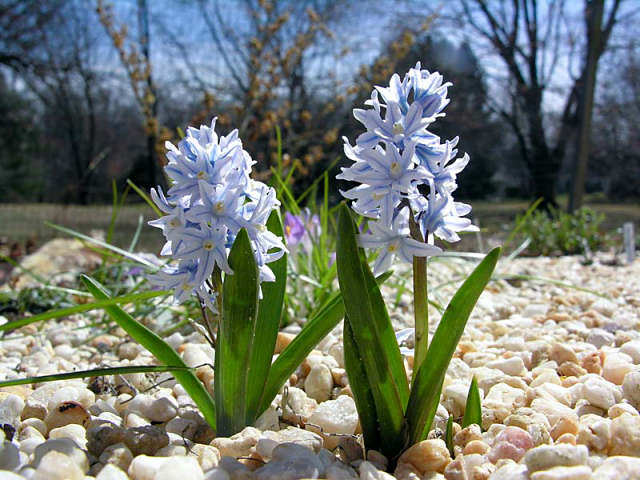
Puschkinia scilloides
Puschkinia, 2014

Early spring bulbs that naturalize (spread by seed) well and go dormant soon after blooming include Siberian squill (closest to a true blue, and also available in white), glory-of-the snow (lavender-blue, pink, or white), and Puschkinia (white flowers with turquoise stripes).  These are all small plants suitable for the front of the border.  If you have a shady lawn under deciduous trees, they will do well there planted in the thin grass.   Anemone blanda is a delightful little naturalizer.  Flowers in blue/purple, pink, or white, attractive ferny foliage, long bloom time, and animal resistance all combine to make it a great edging for a flower bed.  Grecian windflower is not a true bulb; instead, it has odd-shaped dark little tubers.  Soak them briefly in warm water before planting, and don’t worry about which side of the tubers is up.

Spanish bluebell is a late spring bloomer that multiplies well.  Tolerant of partial shade, it blooms in lavender-blue, pink, or white.  Like most bulbs, it is more effective in the landscape in groups of a single color.  When I moved a Hosta last year, I was just stunned by the number of nearby bluebell bulbs I found.  The taxonomists keep changing the scientific name, but the most recent version is Hyacinthoides hispanica.

Fritillaria meleagris, the checkered lily or guinea hen flower, is a small plant with narrow inconspicuous foliage.  The flowers are drooping bells either in mauve with a checkerboard effect, or all white.  Plant this one where it will be easily seen up close.  Native to western Europe, the checkered lily is happy in partial shade and will also naturalize.  The bulbs, however, are delicate, relatively soft and fleshy.  Plant them immediately as they are prone to drying out.

Look for Narcissus ‘Hawera,’ a smaller variety.  A charming May bloomer, its narrow leaves go dormant relatively quickly.   Plant in the front where it can be appreciated.


Ask a Gardener appears weekly in The Journal during the growing season. For answers to other garden, lawn, landscape and pest questions, call Cooperative Extension at 607-272-2292 or email: growline1@gmail.com. This article was written by Patricia Curran, horticulture program manager at Cornell Cooperative Extension of Tompkins County.