Friday, June 14, 2013

Gardener's Weekend in Tompkins County!

After all the rain (our gardens needed rain so it was a blessing!) the sun is shining again and it's going to be a nice weekend, so get out to one or all of these great gardening events in Ithaca and Tompkins County this weekend!

On Saturday, June 15 from 10 am to 4 pm it's the Garden Conservancy's Open Days garden tours. Three unique, quirky and gorgeous gardens will be open for one day only!  For more information, garden descriptions and directions, go to the Open Days information page.
Bedlam Gardens, King Ferry

Bedlam Gardens
          
Lion Garden, Lansing
On Sunday, June 16 from 10 am to 4 pm hop on The Gardener's Trail! Ten locally-owned, unique  specialty nurseries and garden centers will be running free special activities. Hear talks and demonstrations on growing roses and citrus fruits, sample local beer and salsa, take a wagon ride around a farm and orchard, and more! There is also a different raffle prize at each location - no cost to enter, just fill out the entry form at each nursery or garden center that you visit that day!  For more information, activity descriptions and a map of locations, go to the Gardener's Trail information page.

 Earlybird Farm
The Plantsmen Nursery

Baker's Acres


Also on Sunday June 16 from 11 am to 3 pm is the Fall Creek Garden Tour. Private city gardens in downtown Ithaca are open for one day only. This can be a nice walking tour. Pick up a map and garden descriptions at the information table in Thompson Park on Cayuga Street on Sunday morning.

Tuesday, June 11, 2013

What's Eating My Plants?

Your little vegetable plants are finally all planted out in the garden when all of a sudden you start noticing holes in the leaves.

You're wondering, "What's eating my plants? How much damage is ok? Should I do something about it? I don't want to spray anything toxic on my food!"

Flea beetle damage on broccoli leaf
 Photo credit: Whitney Cranshaw, Colorado State University, Bugwood.org

Come to a class at Tompkins County Cooperative Extension this Thursday, June 13 from 6:30-8:30 pm for a workshop on Vegetable Insect Pests. You'll learn to identify stages of common garden pests and their damage, how much damage is acceptable and when you need to take action, plus a range of non-toxic, organic solutions that you can use.

Ladybug larvae, a beneficial insect, eating aphids
Photo credit: Winston Beck, Iowa State University, Bugwood.org

Call (607)272-2292 to register for the workshop on Vegetable Insect Pests this Thursday, June 13 from 6:30-8:30 pm, or send an email to Chrys Gardener at cab69@cornell.edu.  The cost is a sliding scale fee from $5-$10 - you decide how much to pay and no-one will be turned away for inability to pay. 

The workshop will be held at the CCE-Tompkins office, 615 Willow Avenue, Ithaca (near the Sciencenter and Neighborhood Pride grocery store).

Remember the Gardener's Trail this Sunday, June 16! Ten local nurseries will have FREE special activities, tastings, giveaways, wagon rides, tours and more! Go to The Gardener's Trail for event details and a map of nursery locations.

Monday, June 3, 2013

What to do in the Garden this Month

Planting is in full swing!  Enjoy each day in your garden.  Take time to look and acknowledge the new life sprouting and growing all around you. 

What to do in the garden this month:
  • Weed, weed, weed.
  • Avoid overcrowding your plants. Good air circulation helps keep fungal disease at a minimum so pull and thin plants growing too closely together.
  • Plant new batches of bush beans every few weeks to ensure a steady supply of beans to harvest over the growing season.
  • Plant your tomatoes and stake them early. Other cold sensitive plants should go in your garden now as well. If you have started plants from seed, be sure to harden them off before planting in your garden.
  • Pinch back perennials like phlox, beebalm, echinacea and sedum to control height, promote bushiness and delay flowering.
  • Cut fall blooming perennials back 1/2 to 1/3 to encourage fullness and good growth.
  • Deadhead your perennials regularly. This promotes reblooming.
  • Start slug control and scout for fourlined plant bug and tent caterpillar nests. Remove them promptly.
  • Prune spring flowering trees and shrubs as they complete their bloom.
  • Keep watering newly planted plants.
  • Turn your compost.
  • Thin out fruit trees if necessary to ensure fruit of reasonable size. Water the trees, if necessary.

Tuesday, May 21, 2013

The Gardener's Trail, Sunday May 16

Follow the Gardener's Trail and tap into a wealth of horticultural expertise at high-quality, locally-owned nurseries and garden centers within Tompkins County. On Sunday  June 16, 2013, ten different nurseries and garden centers will be offering free talks, demonstrations, tours and samples on a wide range of gardening topics. Free activities will be happening at each business between 10 am and 4 pm so you can visit as many as you like that day to pick up gardening tips, resources, ideas and inspiration!

2013 Gardener's Trail Participants

Baker's Acres nurseryBaker’s Acres, 1104 Auburn Road (Route 34) North Lansing: Hey Dads! Get a free tomato plant with growing instructions! Take in a self guided tour of the demonstration gardens, which will be in full bloom. Baker's Acres also hosts their famous Cornell chicken barbecue every Father's Day so make this your lunch stop! (There is a cost for the BBQ.)

Cayuga Landscape nursery Cayuga Landscape, 2712 North Triphammer Road, Ithaca:  Miniature evergreen plants planted in containers make an interesting change from annuals and they last a lot longer. Learn about different varieties of evergreens for containers and watch demonstrations on container planting.

Climbing roses at Der Rosenmeister nursery  Der Rosenmeister, 190 Seven Mile Drive, Ithaca: The rose display gardens will be in full bloom, so take a tour to see many varieties in flower and also the many creative ways of growing climbing and trailing roses. There will be demonstrations on rose care with a seasonal focus: spring pruning, feeding, weed control and mulching.

Flower display at Agway nursery  Dryden Agway, 59 West Main Street,  Dryden: Visitor's can try samples of Mrs. Wage’s Salsa on chips, washed down with locally-brewed beer  from Bacchus Brewing Company, and pick up  information on growing their own ‘salsa garden’.

George Sheldrake of Early Bird Farm  Earlybird Farms, 806 Elmira Road (Route 13 South), Ithaca
:  Tropical annuals for gardens are hot, hot, hot!  Earlybird propagates a huge variety of colorful summer annuals and will have talks and demonstrations on the best ones for NYS gardens.

Indian Creek apple orchard  Indian Creek Farm, 1408 Trumansburg Road (Route 96) IthacaNursery staff will give demonstrations on planting and staking young fruit trees,and visitors can hop on a wagon ride tour of the vegetable farm and orchard.

Ithaca Agway's nursery  Ithaca Agway, 213 South Fulton Street, Ithaca: The nursery staff will present talks and demonstrations on how to grow and maintain David Austin roses. David Austin's English Roses combine the forms and fragrances of old roses with the repeat-flowering of modern roses. They are very easy to grow, healthy and reliable.

Magic Garden at the Ithaca Farmers Market  Magic Garden, Ithaca Farmers Market, Ithaca: Visit the Magic Gardeners at the Ithaca Farmers Market and  learn how to use unusual tropical annuals in container plantings. See demonstration on potting on into containers and try a free cup of Trinidad bush tea! You can find the Magic Gardeners at booth number 88 from 10 am to 3 pm.

Flowering annuals at Michaleen's   Michaeleen’s, 2826 North Triphammer Road, Ithaca:  Wouldn't you love to pick your own oranges for breakfast? Staff will give presentations on growing citrus fruit trees indoors with a selection of sizes and varieties of citrus fruit trees available for sale. Visitors can also sample free baked goods made with citrus infusions and wash them down with cold lemonade.

The Plantsmen nursery  The Plantsmen, 482 Peruville Road, Groton: Watch a demonstration on how to use coir logs. Coir is a natural fiber extracted from the husk of coconut. Coir logs are an ecological way to stabilize edges of ponds and stream banks.

Click the map below  to view locations of participating nurseries and garden centers.

Come to Ithaca for a Gardener's Weekend - June 15 and 16!

Open Days Garden Tours - Saturday June 15, 10 am to 4 pm

The Tompkins County Open Days Garden Tour is taking place on Saturday June 15 from 10 am to 4 pm (one day before the Gardener's Trail).Three fabulous private gardens will be open for one day only! Make a full gardener's weekend out of it by touring the open gardens on Saturday, then follow the Gardener's Trail on Sunday where you will learn tips and techniques to help make your own garden fabulous! Admission is $5.00 per garden.

Monday, May 13, 2013

Eat the Invaders!

I've been pulling invasive garlic mustard out of my woods and fields the last few weeks. While yanking out the fast-growing, prolifically seeding invaders, the garlicky aroma of the leaves got me thinking that I should be eating it. Usually I throw the pulled up plants in the garbage so they don't spread through my compost pile.

Garlic mustard in flower

You can imagine how excited I was to come across a website called Eat the Invaders! which promotes eating invasive plant and animal species as a way to control them. The website has recipes and cooking tips for invasive thugs like japanese knotweed, curly dock, garlic mustard, and even for invasive animals like nutria (looks similar to a guinea pig) and carp. 

Here's a recipe from the website for
Garlic Mustard Pesto

Wildman Steve Brill has served this pesto on his tours of Central Park in New York. He told us we could post it, with a link to his website.
4 cloves of garlic
3 tablespoons garlic mustard taproots
3/4 cups parsley
1 cup garlic mustard leaves
1 cup basil
2 cups walnuts or pine nuts
1/2 cup mellow miso
1 1/4 cup olive oil or as needed
Chop the garlic and garlic mustard roots in a food processor.
Add the parsley, garlic, garlic mustard and basil and chop.
Add the nuts and chop coarsely.
Add the olive oil and miso and process until you’ve created a coarse paste.
Makes 4 cups

Weed 'em and reap!

Thursday, May 9, 2013

Growing Fava Beans in Upstate NY, Part 2

When I last blogged about my fava bean experiment at the end of March, the plants in the greenhouse looked happy and healthy, like this:

My dilemma was that the greenhouse was starting to hit pretty high temps on sunny days, and fava flowers won't make bean pods if they are exposed to warm temperatures (above 80 F). I had to get the plants out of the warm greenhouse and take a chance on planting them outside.  Palm Sunday (March 24) was sunny and in the 50's. I planted some of each variety in the garden and put the rest outside on an open porch to harden off. 

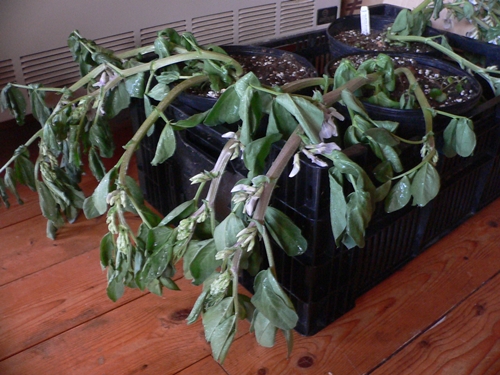
The following week the temperature plummeted, and on Good Friday (March 29) it went down to 20 F, even though it was only predicted to go to 25 F. The next day the plants that were in pots on the porch looked like this:
The were severely  wilted but not completely turned to mush, so it seemed that there was hope for them. The plants outside had some protection from the earth's warmth and looked only slightly better. 
I brought the potted plants inside and watered them well,and covered the outside plants with a sheet to protect them from more cold damage.


 By two days later, on Easter Sunday (March 31) the plants were resurrected! This is how they looked - still lax but definitely not frozen. Even the flower buds survived the extreme cold!

 I trimmed off any parts that didn't come back to life, planted the potted plants and staked them all to help them stand up.

 For the next few weeks after being frozen, the plants continued to flower but no pods were forming. I started to worry that either the heat in the greenhouse, or the extreme cold, had rendered the flowers sterile. Then this week, finally the sight I have been waiting for:
 Baby fava beans forming on the plants!

Notice how the pods form upward on the plant instead of down like other species of beans. These pods will get very large, 8 to 12 inches long, and when the beans inside are ready the pods turn in a downward direction and they are twisted off. 

So why am I going to all this trouble? Fava beans have an indescribable flavor that is unlike bush beans or runner beans. It's as distinctive as asparagus......I'm not saying they taste like asparagus but that they have a unique flavor that somehow captures the essence of spring and are a quintessential spring treat.

I learned two important things from this experiment: 
1. Wait until February to sow the beans in a greenhouse so that the flowering is delayed until April when it's safer to plant them outside. I sowed these beans in November and then they started flowering in the greenhouse in March, just when the greenhouse was really heating up during the day. The flowers abort if they are exposed to prolonged heat (over 80F). 

2. The plants can be exposed to very cold temperatures and still survive. I knew that 'Banner' was rated to be hardy to 15F, but all four varieties (+ Dreadnought, Aqua Dulce and Crimson Flowered) survived several nights in the low 20's. This means they would be fine planted outside in April even though there can be many nights below freezing then. Of course, covering them with row cover or sheets would also be a good idea, but for this experiment I was curious to see how they would do with no protection whatsoever.

Now it remains to be seen how many pods we will actually harvest after all this! The plants are only 18" or so tall - quite puny compared to the big healthy plants (3-4') we could grow in the mild winter climate of County Clare, Ireland. Maybe next year with later sowing and transplanting dates..............

Wednesday, May 1, 2013

What to do in the Garden this Month

Traditionally, the last frost hits at the end of this month.  Woo Hoo!!  Although we don't know what Mother Nature has in store, it's time to gather our seedlings and start hardening them off.

What to do in the garden this month:
  • Mow your lawn at least 3 inches high to promote deeper, healthier root growth.
  • If you fertilize your lawn, the first application can put down the last week of this month.
  • Plant your brassicas now, including: broccoli, cauliflower, Brussels sprouts and summer cabbage.
  • Leeks can be moved to their final growing place in your garden.
  • Begin harvesting your salad greens.
  • Leave bulb foliage intact until it yellows and wilts.  The foliage is required for strong bulb growth.
  • Keep an eye out for white trails on columbine leaves.  This is caused by a leaf miner.  Remove and destroy infested leaves as you see them.
  • Plant annuals in bare spots in your garden.
  • If you have deer, don't forget to use your deer repellent!
  • Turn  your compost pile.
  • Weed, weed, weed. 

As the weather warms and the itch to work outside intensifies, remember to take a few minutes each day to smell the new flowers and enjoy each new sprout and shoot.